Heavy-Duty Landscape Fabric for Gravel, Rock & Creek Beds
Heavy-Duty Landscape Fabric for Gravel, Rock & Creek Beds
Garden-grade weed fabric works well under mulch in a flower bed. Put it under a gravel path or a river-rock bed and it usually fails within a season or two: sharp stone punctures it, foot traffic grinds it, and weeds come up through every tear. Gravel, rock and dry creek beds need heavy-duty landscape fabric of at least 4 to 5 oz per square yard, pinned closely and covered deeply, because the stone on top is what destroys lighter fabric.
This guide covers how to choose heavy-duty landscape fabric for gravel, rock and dry creek beds: which weight to buy, woven vs non-woven, how much cover to use, and the installation details that make the difference.
For the basics of weed barrier fabric and installing it in planting beds, see our landscape weed barrier fabric guide.
Why gravel and rock need heavier fabric
Under mulch, a fabric mainly has to block light. Under stone it has a harder job:
Puncture. Angular gravel and crushed stone press sharp edges into the fabric every time someone walks on it.
Abrasion. Stones grind against the fabric as they shift under foot traffic, wheelbarrows and mowers.
Load. A rock bed or a path base puts constant weight on the fabric, and any thin or stretched spot tears.
Separation. Over time, light fabric lets stone sink into the soil, so the path thins and needs topping up.
A heavy-duty fabric holds the stone on top and the soil underneath, which is why landscapers use it under paths, patios and rock gardens.
What weight of landscape fabric for gravel?
Fabric weight is measured in ounces per square yard (oz/yd²). Heavier fabric is thicker and stronger.
Application | Suggested weight | Notes |
|---|---|---|
Flower beds under mulch | 2 to 3 oz/yd² | Garden grade is enough |
Pea gravel paths, decorative gravel | 4 to 5 oz/yd² | Rounded stone is gentler on fabric |
Crushed stone, river rock, rock gardens | 5 oz/yd² or more | Sharp edges and heavier stone |
Dry creek beds | 5 oz/yd² or more | Large rock plus flowing water |
Under pavers or a path base | 5 oz/yd² or more | Used as part of a compacted base system |
When in doubt, go heavier. The fabric is a small part of the cost of a gravel project, and replacing it means moving all the stone.
Woven vs non-woven fabric under gravel
Woven fabric is made from interlaced polypropylene strips. It has high tensile strength and resists tearing under load, so it is a common choice under gravel paths, rock beds and hardscape.
Non-woven fabric is a felt-like sheet of bonded fibers. It drains and filters very well and moulds around uneven ground, and it is often chosen where drainage matters most, such as behind retaining walls and under drainage stone.
Woven | Non-woven | |
|---|---|---|
Tear and tensile strength | Higher | Lower at the same weight |
Water flow | Good | Very good |
Best under | Gravel paths, rock beds, pavers | Drainage rock, French drains, wall backfill |
Conforms to uneven ground | Less | More |
For most gravel paths and rock landscaping, a heavy woven fabric is the practical choice. On a dry creek bed that has to carry fast-moving runoff, plan the drainage first, then choose a fabric that lets water pass freely.
How deep should gravel be over landscape fabric?
Pea gravel and decorative gravel: 2 to 3 inches
Crushed stone paths: 3 to 4 inches
River rock and rock beds: at least 3 to 4 inches, or one full layer of rock with no fabric showing
Dry creek beds: a bedding layer of smaller gravel first, then the larger rock
Fabric that is exposed to sunlight breaks down much faster, so cover every part of it.
How to install landscape fabric under gravel or rock
Clear and dig out the area. Remove all weeds and roots, then excavate deep enough for your stone layer so the finished surface sits at the right height.
Grade and compact the base. Slope it slightly so water runs off, then compact the soil to reduce settling and shifting later.
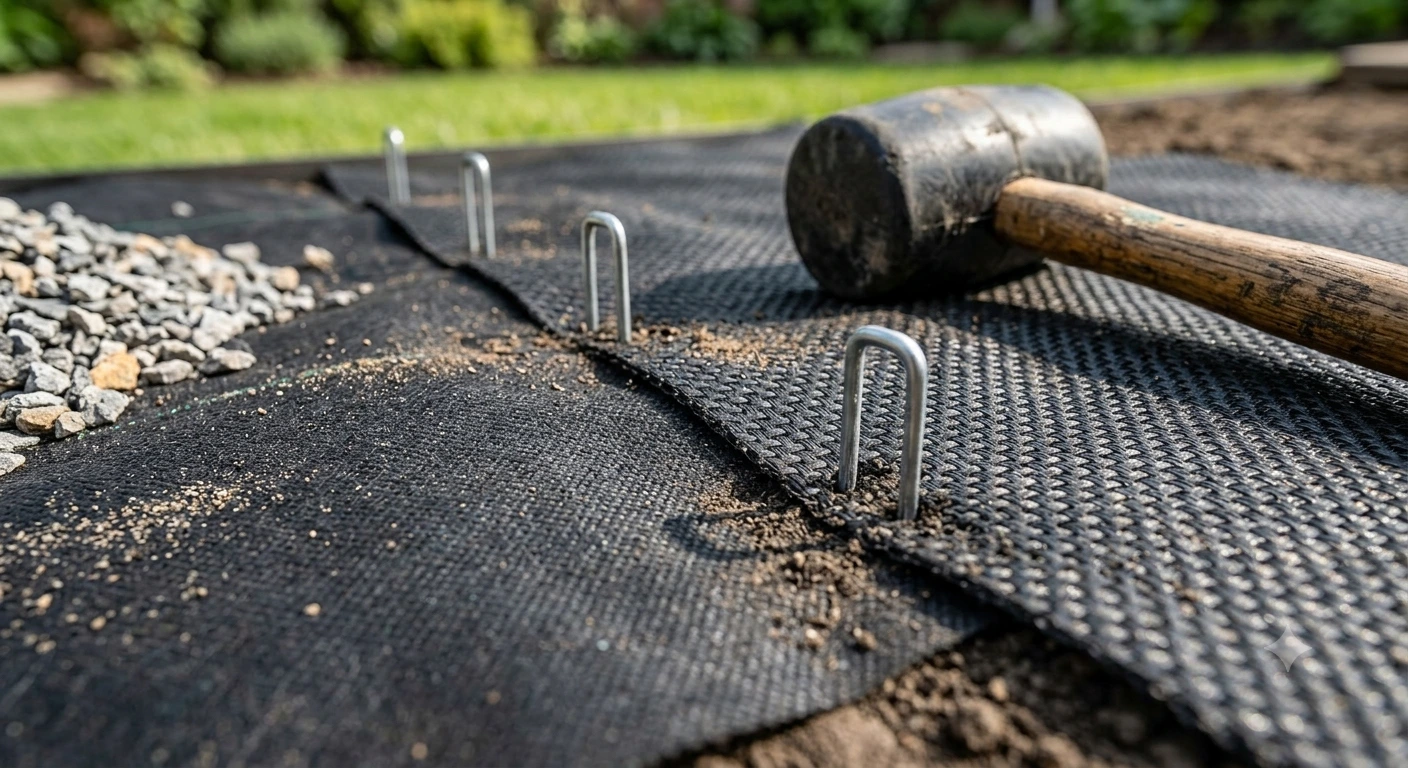
Unroll the fabric across the area without stretching it tight. Overlap neighbouring sheets by 8 to 12 inches, and keep seams out of the main walking line where you can.
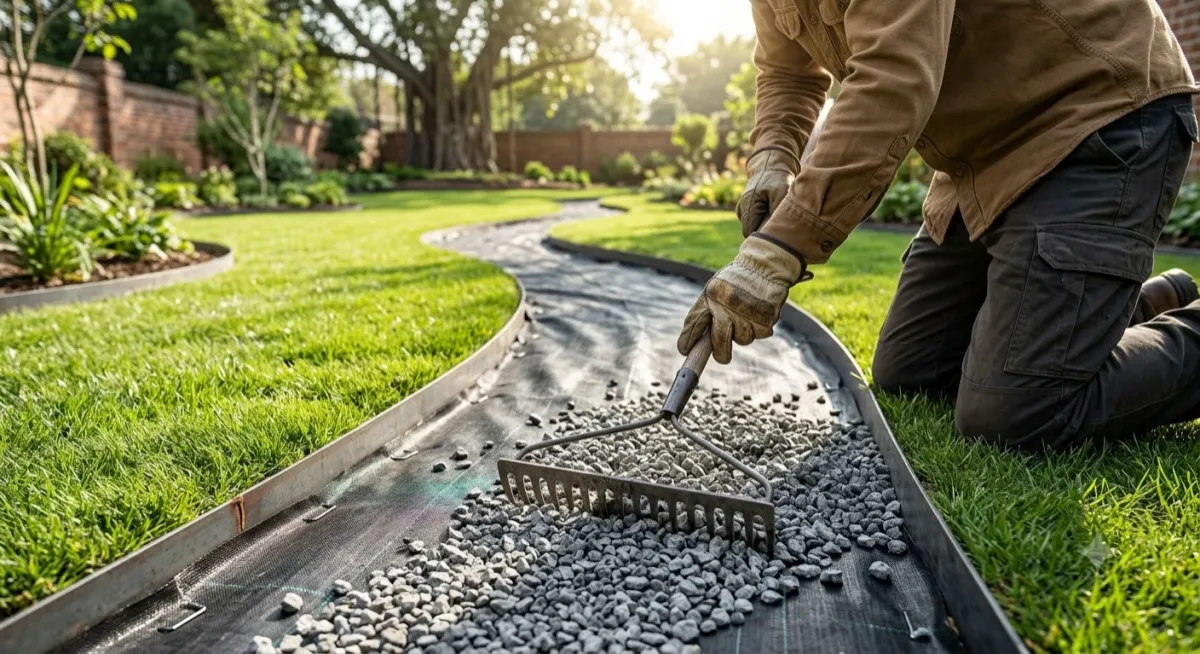
Pin it closely. Use contractor-grade landscape pins every 2 to 3 feet, with extra pins along edges, seams and curves.
Install edging along paths and beds so gravel stays in place and the fabric edge stays covered.
Spread the stone carefully. Tip it onto the fabric and rake it out. Don't drag wheelbarrows, rakes or heavy rock across bare fabric.
Place large rocks gently. In a dry creek bed or rock garden, set boulders down instead of dropping them, and lay a bedding layer of smaller gravel first.
Dry creek bed tips
Follow the natural low line of the yard so the bed carries water where it already wants to go
Line the full width of the channel and run the fabric up both banks
Place the largest rocks along the edges and at bends, where moving water pushes hardest
Fill between the large rocks with smaller river rock so no fabric is visible
Common mistakes
Using garden-grade fabric under gravel. It is the most common reason weeds come back through a path.
Too little cover. A thin layer of gravel leaves fabric exposed to sun and foot traffic.
Too few pins. Fabric moves under stone, and seams open up.
Overlaps that are too small. Weeds find a 2-inch overlap within one season.
Skipping edging. Gravel migrates, the fabric edge shows, and it degrades in the sun.
BCP WeedShield Pro
BCP WeedShield Pro is BCP's heavy-duty, contractor-grade landscape fabric for gravel, rock and hardscape.
5 oz/yd² heavy-duty woven polypropylene
High UV resistance, with a 10+ year lifespan when covered
High tensile strength under gravel, stone and foot traffic
Water and air permeable, so it doesn't cause pooling
Rolls of 4 ft x 100 ft, 6 ft x 250 ft and 12 ft x 250 ft
For garden beds under mulch, the lighter WeedShield Standard (3 oz/yd²) is easier to cut and shape. You can compare both on the BCP landscape fabric page.
Frequently asked questions
Should you put landscape fabric under gravel?
Yes, for most paths and rock beds. Fabric stops gravel from sinking into the soil and blocks most weeds from below. Use a heavy-duty grade; light fabric tears under stone.
What is the best landscape fabric for gravel?
A heavy woven polypropylene fabric of around 5 oz/yd², UV-stabilized and pinned every 2 to 3 feet, suits most gravel paths and rock gardens.
Will weeds grow through landscape fabric under gravel?
Weeds from below are blocked when the fabric is heavy enough and the seams overlap well. Over time, some weeds can sprout in dust and debris that collect on top of the gravel. Those are shallow-rooted and easy to pull.
Can you use landscape fabric under a driveway?
Heavy-duty fabric can be used as part of a properly built, compacted driveway base, where it helps separate the stone from the soil. Driveways carry vehicle loads, so follow a base design suited to the soil and traffic.
Woven or non-woven for a dry creek bed?
Both are used. Woven fabric resists tearing under heavy rock, and non-woven lets water pass very freely. Most important is choosing a heavy grade, covering it fully, and bedding large rocks on smaller gravel.
Get the right fabric for your project
Before you order, have ready:
Area to cover (length and width), plus any overlap allowance
What goes on top: pea gravel, crushed stone, river rock or pavers
Whether the area carries foot traffic, equipment or water flow
Request a landscape fabric recommendation
Send us your project details, and our team will recommend the right fabric grade and roll size. Or call 877-540-5678.
