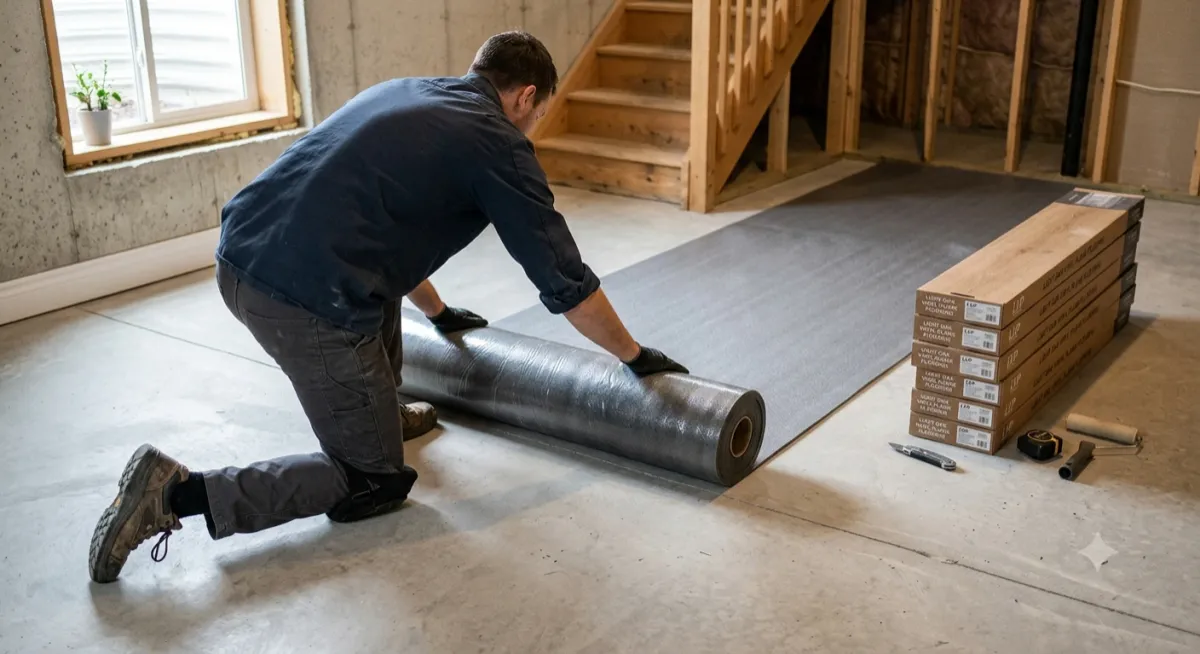
Underlayment for vinyl plank flooring
Underlayment for Vinyl Plank Flooring: Do You Need It?
Vinyl plank flooring is marketed as "waterproof", so many buyers assume nothing needs to go under it. The plank may be waterproof, but the subfloor underneath isn't, and noise, cold and moisture all come up from below. Most vinyl plank floors need some form of underlayment. The right one depends on whether your planks already have a pad attached and whether you are installing over concrete or wood.
This guide covers when you need underlayment for vinyl plank (LVP), which type to use over concrete and plywood, how thick it can be, and how to install it so you don't void the flooring warranty.
Installing laminate instead? See our complete guide to laminate floor underlayment.
Do you need underlayment for vinyl plank flooring?
It comes down to two questions.
1. Does the plank have an attached pad? Many rigid-core (SPC and WPC) planks come with a thin foam or cork backing already bonded to them. Adding a second cushion layer under these usually makes the floor too soft, which strains the click joints, and most manufacturers prohibit it.
2. What is the subfloor? Concrete releases moisture vapor for its whole life, so it almost always needs a vapor barrier. Wood subfloors don't need a vapor barrier in most rooms, but they benefit from sound control, especially upstairs.
Your situation | What to put under the planks |
|---|---|
Planks with attached pad, over concrete | A 6-mil polyethylene vapor barrier only (no extra cushion), unless the flooring maker says the pad already includes one |
Planks with attached pad, over plywood or OSB | Usually nothing; follow the flooring maker's instructions |
Planks with no pad, over concrete | An underlayment with an integrated vapor barrier |
Planks with no pad, over plywood or OSB | An acoustic underlayment rated for LVP |
Upstairs rooms or apartments | An acoustic underlayment that meets the building's IIC and STC rating |
Glue-down (dry back) vinyl | No underlayment; the planks are bonded straight to a prepared subfloor |
What underlayment does under vinyl plank
Blocks moisture. Vapor rising from a slab can lead to mold under the floor and can loosen the click joints over time.
Reduces noise. It softens footfall in the room and cuts impact noise to the room below.
Smooths small imperfections. A thin underlay hides minor texture and small dips in the subfloor. It doesn't fix a floor that is out of flat.
Adds a little warmth and comfort. This matters most over concrete in basements.
Types of underlayment for vinyl plank
Type | Best for | Watch out for |
|---|---|---|
Foam or cross-linked polyethylene with a vapor film | Floating LVP over concrete or wood | Check the maximum thickness your plank allows |
Rubber | High sound control in multi-family buildings | Heavier and more expensive; some rubber products can stain vinyl, so use one approved for LVP |
Cork | Sound and warmth | Needs a separate vapor barrier over concrete |
Felt | Sound absorption | Usually too soft for rigid-core planks |
6-mil poly film only | Planks with an attached pad, over concrete | Gives moisture protection only, no cushion |
How thick should underlayment be for vinyl plank?
Thinner than most people expect. Vinyl planks are thin and rely on tight click joints, so a thick or soft layer underneath lets the joints flex every time someone walks over them.
Most rigid-core planks allow 1 to 2 mm of added underlayment. Some allow up to 3 mm of a dense pad.
Thin flexible LVP is more sensitive to soft underlayment than rigid-core SPC.
The flooring manufacturer's limit always wins. It is printed in the installation instructions, and going beyond it is one of the most common reasons warranty claims are refused.
Vinyl plank over concrete
Concrete is where underlayment matters most, because slabs push moisture upward all the time, including slabs that look and feel dry.
Test the slab. A simple plastic-sheet test (tape a 2 ft square of poly to the slab for 24 to 48 hours) will show visible moisture. For basements and new slabs, a calcium chloride or relative-humidity test gives a number you can compare with the flooring maker's limit.
Check flatness. Most LVP needs the floor flat to within about 3/16 inch over 10 ft. Grind high spots and fill low spots with a patching compound before laying anything.
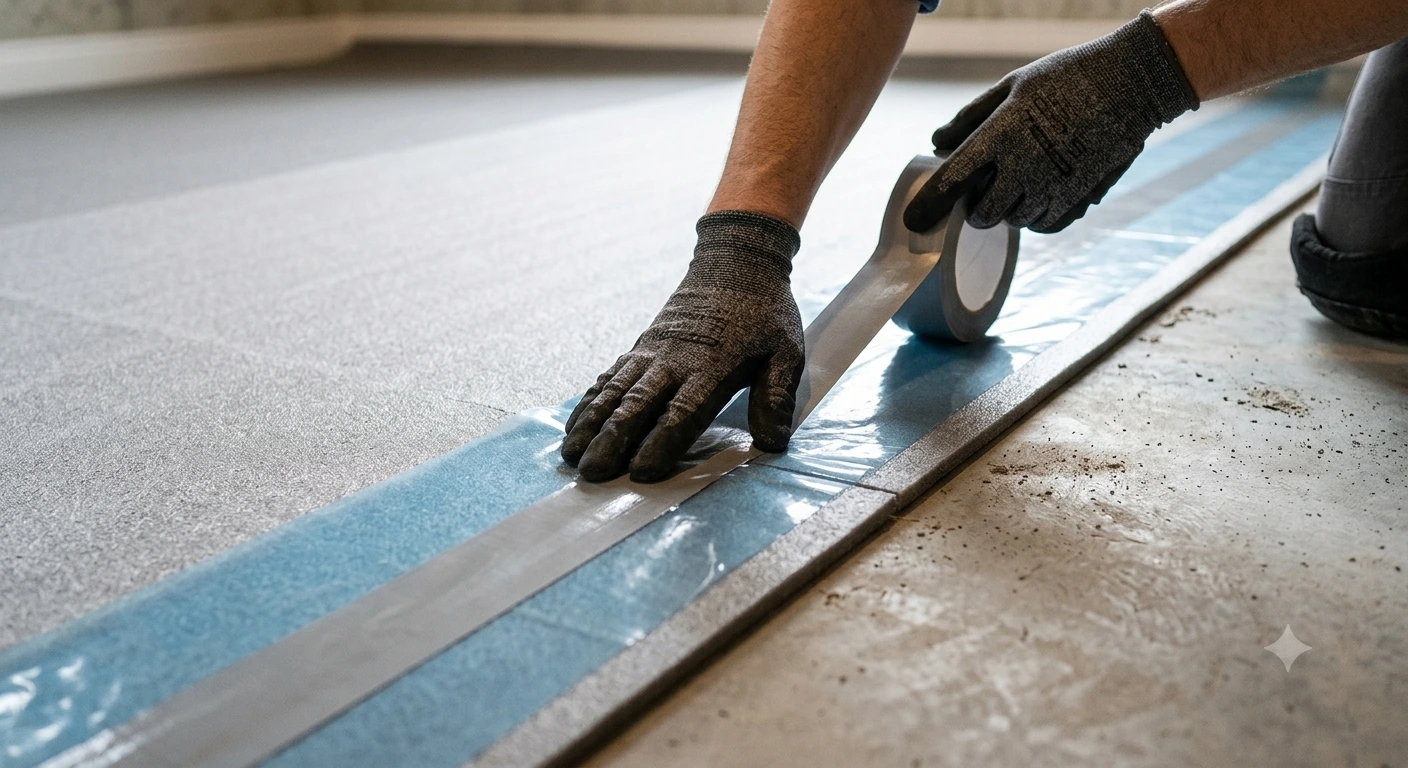
Lay the vapor barrier or barrier underlayment with seams overlapped and taped, running it a couple of inches up the walls and trimming it behind the baseboard.
Float the planks over the top, leaving the expansion gap the flooring maker specifies.
Vinyl plank over plywood or OSB
Wood subfloors don't usually need a vapor barrier unless they sit over a damp crawl space. The main jobs are sound and smoothness.
Screw down any squeaky or loose panels before you start
Sand proud seams and fill gaps or old nail holes
Use an acoustic underlayment if the planks have no attached pad, especially on upper floors
Over a crawl space, make sure the ground there is covered with a vapor retarder
How to install underlayment under vinyl plank
Clean the subfloor of dust, grit and debris. A single pebble under a thin plank can show through and crack the core.
Roll out the underlayment across the room, in the same direction you will lay the planks.
Face the vapor barrier side up, toward the flooring, when the product has a film or foil face.
Butt or overlap seams as the product instructions say (overlapping 2 to 4 inches is common for barrier underlays) and seal them with moisture-resistant tape.
Lay only a few rows ahead of the planks so you don't walk on and tear the underlayment.
Keep the expansion gap at every wall, and don't puncture the vapor barrier with fasteners or tools.
Common mistakes
Doubling up the cushion. Putting foam under planks that already have an attached pad.
Skipping the vapor barrier on concrete because the planks are labelled waterproof.
Using an underlay that is too thick, so the joints separate or peak after a few months.
Leaving seams untaped, which lets moisture find the gap.
Not reading the flooring warranty. It says exactly what is and isn't allowed underneath.
BCP SilentShield floor underlay
BCP SilentShield Floor Underlay is built for floating floors, including luxury vinyl plank and tile, laminate and engineered hardwood.
2 to 3 mm high-density foam or cross-linked polyethylene
Integrated vapor barrier film for installs over concrete slabs and damp subfloors
Sound ratings of IIC 70 or higher and STC 65 or higher (results vary by floor type)
Mold- and mildew-resistant, and compatible with underfloor heating
Pre-marked grid lines, in 3 ft x 30 ft (90 sq ft) and 4 ft x 100 ft (400 sq ft) rolls
Before ordering, compare the SilentShield thickness with the maximum underlayment thickness in your plank's installation instructions.
Frequently asked questions
Can you put vinyl plank flooring directly on concrete?
You can float planks directly over concrete only if the slab is dry, flat and covered with a vapor barrier, or if the planks have an attached pad that the flooring maker says includes one. Laying unprotected planks on bare concrete risks trapped moisture and mold.
Do I need underlayment if my vinyl plank has a pad attached?
Usually not, apart from a 6-mil vapor barrier when you are installing over concrete. Adding another cushion layer under an attached pad generally voids the warranty.
What is the best underlayment for vinyl plank flooring?
For most floating LVP, the best choice is a thin, dense underlayment of 1 to 3 mm with a built-in vapor barrier, as long as it is within your plank's thickness limit. Upstairs or in apartments, choose one with published IIC and STC sound ratings.
Can I use laminate underlayment under vinyl plank?
Only if the product says it is suitable for LVP. Many laminate underlays are too soft or too thick for vinyl's click joints.
Which side of the underlayment faces up?
The vapor barrier side, usually the film or foil face, faces up toward the flooring, unless the product instructions say otherwise.
Get the right underlay for your floor
Before you order, have ready:
Room size in square feet
Subfloor type (concrete slab, plywood or OSB)
Your plank brand, and whether it has an attached pad
Any sound rating your building requires
Request a floor underlayment recommendation
Send us your project details, and our team will recommend the right underlayment and roll size. Or call 877-540-5678.
