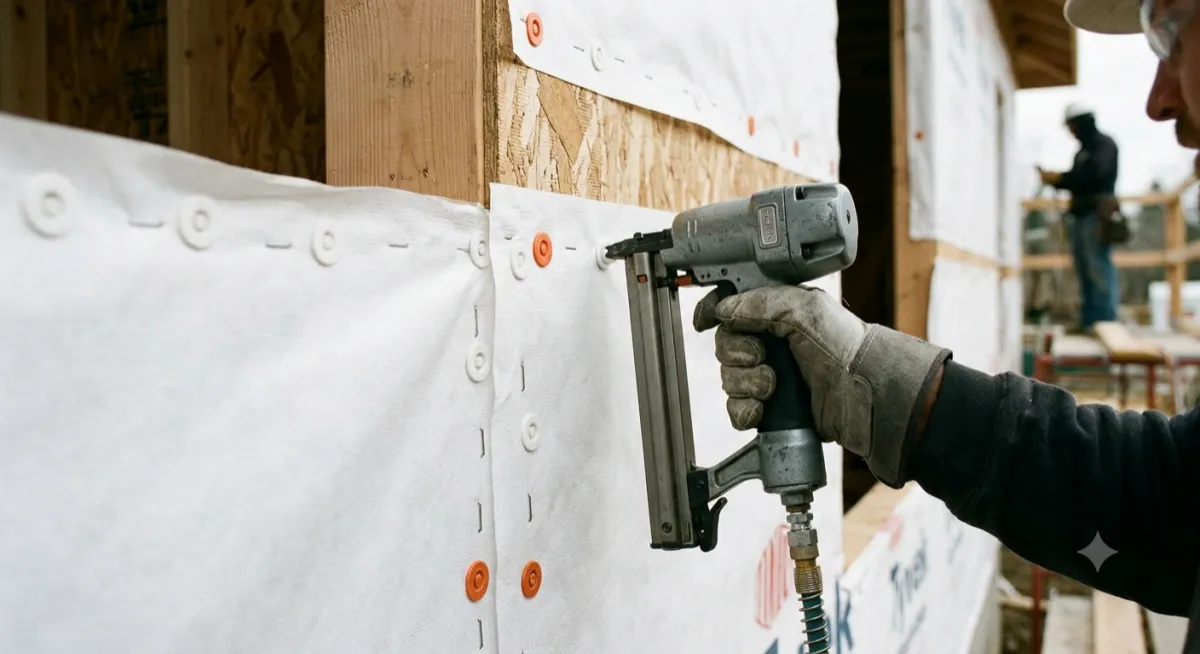
House Wrap Fasteners: Cap Nails, Cap Staples & Tape
House Wrap Tape, Cap Nails and Staples: What to Use and How
House wrap is only as good as the way it is held on and sealed. A good weather-resistant barrier attached with bare staples, or seamed with the wrong tape, can tear in the wind, leak at every overlap and fail an inspection. Most house wrap manufacturers now require cap nails or cap staples, which are fasteners with a plastic cap around 1 inch across, plus a compatible seam tape — and the product's own installation instructions, not habit, are what an inspector checks.
This guide covers which fasteners to use, how far apart to space them, which tape to use where, and the mistakes that cause most house wrap failures.
Why fasteners matter
House wrap is a thin, flexible membrane. A bare staple or small-head nail concentrates the load in one tiny point, so wind gusts during construction, foot traffic and the wrap's own weight can tear it around the fastener. Every one of those tears is a hole in the water barrier.
A cap fastener spreads that load across the cap. The wrap stays attached, stays flat, and the hole the fastener makes is covered by the cap itself.
Cap nails vs cap staples
Fastener | How it is installed | Best suited to |
|---|---|---|
Cap nails | Plastic cap with a ring- or smooth-shank nail, driven by hand or with a cap nailer | Wood sheathing, small jobs, areas where a nailer is easier to control |
Cap staples | Plastic cap with staple legs, driven with a pneumatic cap stapler | Production framing, large wall areas, fast installation |
Bare staples (hammer tacker) | Standard staples, no cap | Not recommended; most manufacturers do not allow them |
Both cap nails and cap staples do the same job. The choice usually comes down to the tool the crew already uses and the volume of wall to cover. What matters is that the fastener has a cap, is long enough to hold in the sheathing or framing, and is installed at the spacing the wrap's instructions specify.
Fastener spacing
Follow the spacing in your wrap manufacturer's installation guide. As a reference point, BCP's installation guidelines for WrapSecure house wrap call for securing the wrap with cap nails or staples every 12 to 18 inches along the studs.
A few practical rules apply to almost every product:
Fasten into framing or structural sheathing, not just into foam or other soft substrates
Add fasteners near seams, edges and the top of each course
Do not overdrive fasteners; the cap should sit flat without crushing or tearing the wrap
Do not leave large unfastened areas that can flap in the wind before the siding goes on
Seam tape: what it does and where it goes
Tape turns individual sheets of wrap into one continuous barrier. It seals:
Vertical and horizontal seams between courses
Fastener penetrations where required
Tears and cuts made during installation
Penetrations for pipes, vents and wiring
Use the tape the wrap manufacturer specifies or approves. Tapes are formulated for particular membranes, and a tape that does not bond properly to the wrap's surface will lift over time. General-purpose duct tape and packing tape are not a substitute.
Tape also needs a clean, dry surface. Dust, frost or moisture on the wrap is one of the most common reasons seam tape fails to stick. Press the tape down firmly along its full length.
Not every manufacturer requires every seam to be taped, so check your product. Where the instructions call for taped seams, they are part of the barrier, not an optional extra.
Flashing tape is different from seam tape
Windows, doors and other openings need flashing tape (typically a self-adhered flashing membrane), not just seam tape. Flashing is what directs water out of the wall at the most vulnerable points of the building envelope.
BCP's WrapSecure guidelines call for approved flashing tape at all seams, openings and penetrations, and for integrating the wrap with window and door flashing so water is directed outward. The general rule is that every layer should lap over the layer below it, shingle-style, so water running down the wall is always shed outward.
Overlaps
Fasteners and tape only work if the sheets overlap correctly. BCP's WrapSecure guidelines specify:
Install from the bottom up, so upper courses lap over lower ones
Overlap horizontal seams by at least 6 inches
Overlap vertical seams by at least 12 inches
Unroll the wrap horizontally with the printed side facing out
Mistakes that cause most house wrap failures
Bare staples. Fast to install, but they tear out in the wind and most manufacturers do not permit them.
Reverse laps. An upper sheet tucked behind a lower one, or flashing lapped the wrong way, channels water into the wall instead of out of it.
Tape on a dirty or wet surface. It looks sealed on the day and lifts within weeks.
Leaving the wrap exposed too long. House wrap has a UV exposure limit. BCP WrapSecure is rated for up to 6 months of exposure, and its guidelines say cladding should be installed within 180 days of wrap installation.
Mixing systems. Using one brand's wrap with another's tape and flashing makes it harder to show the assembly was installed to a single manufacturer's instructions.
BCP WrapSecure at a glance
Micro-perforated or woven polypropylene weather-resistant barrier
Water resistant and vapor permeable, so moisture can escape from the wall assembly
UV resistance for up to 6 months of exposure
Roll sizes of 3' × 100', 9' × 100' and 9' × 150'
Installed with cap nails or staples and seam tape
Meets ASTM E2357 and ICC-ES AC38
For the full installation sequence, see our guide on how to install house wrap.
Frequently asked questions
Can I use regular staples on house wrap?
Most manufacturers do not allow bare staples, because they tear out of the membrane. Use cap staples or cap nails, as the product's instructions specify.
What size cap do house wrap fasteners need?
Plastic caps of around 1 inch in diameter or larger are standard. Check your wrap's installation guide for the exact requirement.
How far apart should house wrap fasteners be?
Follow the manufacturer's instructions. BCP's WrapSecure guidelines specify cap nails or staples every 12 to 18 inches along the studs.
Do I have to tape every house wrap seam?
It depends on the product. Many manufacturers require taped seams; some do not. Where taping is specified, it is part of the barrier and should not be skipped.
Can I use duct tape on house wrap?
No. Use the seam tape the wrap manufacturer specifies. General-purpose tapes do not bond reliably to house wrap and tend to lift over time.
Get house wrap for your project
Before requesting a quote, have ready:
Total wall area to be wrapped
Preferred roll width: 3 ft or 9 ft
Wall sheathing type
Project timeline, including when cladding will go on
Send us your project details, and our team will come back with roll quantities for BCP WrapSecure. Or call 877-540-5678.
