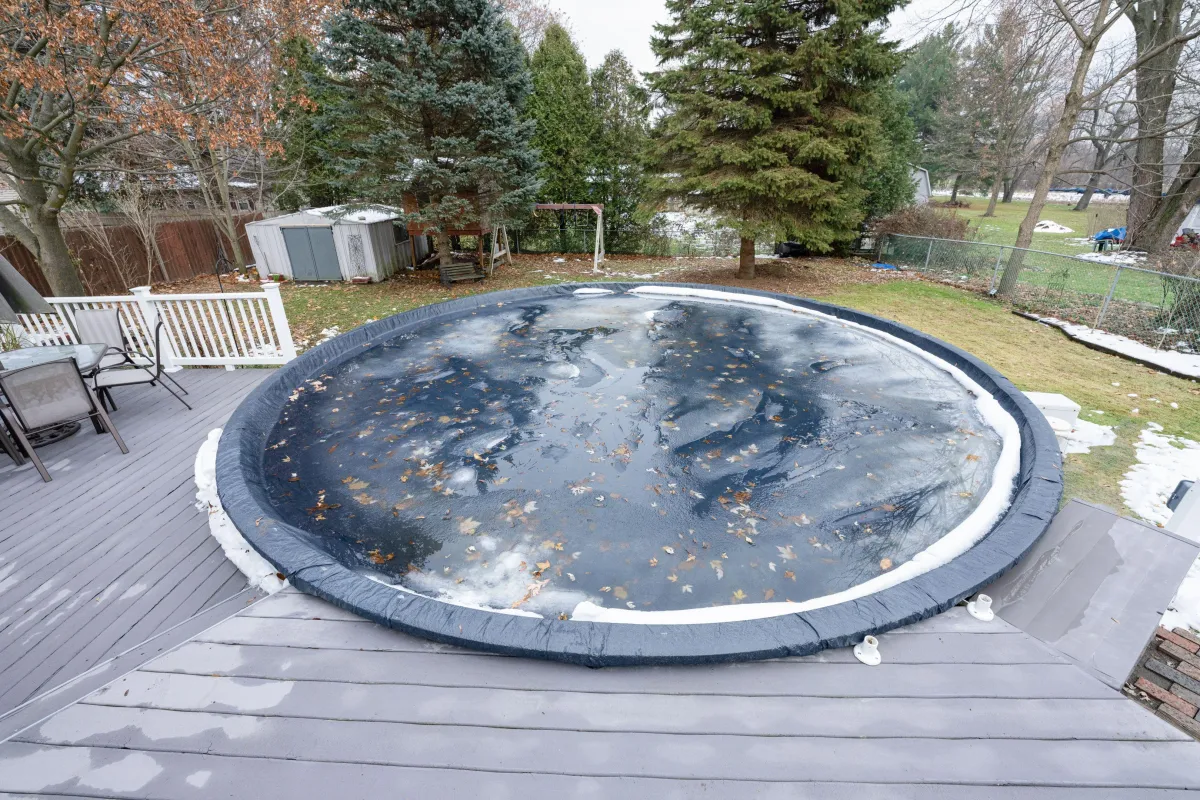
Tarp Pool Cover: Can You Use a Tarp to Cover a Pool?
Tarp Pool Cover: Can You Use a Tarp to Cover a Pool?
Closing an above-ground pool for the season and wondering if a tarp will do the job? It can, as long as you know what a tarp is and isn't built for. A heavy-duty tarp works well as a temporary or winter debris cover for an above-ground pool, but it is not a safety cover and should never be trusted to hold a person or a pet.
This guide covers when a tarp makes sense as a pool cover, how to size and secure one, how to deal with rain and snow on top, using a tarp under an above-ground pool, and which tarp grade holds up through a winter.
If you're also putting a boat away for the season, see our boat tarp winter storage guide.
Can you use a tarp as a pool cover?
Yes, for the right job. A tarp is a practical cover when you want to:
Keep leaves, dirt and debris out of an above-ground pool over fall and winter
Cover a pool for a short break, such as a week away or before a storm
Replace a torn cover until a new fitted cover arrives
Cover an odd-shaped or temporary pool that a standard cover doesn't fit
A tarp is the wrong choice when you need a safety cover. Safety covers are anchored and rated to carry weight. A tarp only sits on the water or across the top rail, so anyone who steps on it can fall in. If children or pets can reach the pool, fence it off or use a cover made for safety.
Tarp vs fitted pool cover
Tarp | Fitted winter pool cover | |
|---|---|---|
Fit | Any size or shape you can drape | Made for one pool size |
Securing | Rope, cable or water bags through grommets | Cable and winch or built-in anchors |
Cost | Lower | Higher |
Safety rating | None | Only safety covers carry one |
Best for | Debris protection, short-term cover, odd shapes | Every-season winterizing of a standard pool |
For a standard round above-ground pool that you close every year, a fitted winter cover is the simpler long-term option. For debris control, a stopgap or a pool shape that standard covers don't fit, a well-secured tarp does the job for less.
How to size a tarp for a pool
Measure the pool. For a round pool, measure the diameter across the top rail. For an oval or rectangle, measure the length and width.
Add overhang on every side. The tarp has to drape over the top rail and down the outside wall far enough to tie off. A common rule is to add a few feet beyond the pool edge on every side, and more if you plan to let the tarp sag onto the water.
Round up. A tarp that is too small pulls off the rail the first time water or snow collects on it. If you're between sizes, choose the bigger one.
How to cover a pool with a tarp
Clean and balance the water first. Skim out leaves, brush and vacuum, and winterize the water as you normally would. Anything left in the pool sits under the tarp all winter.
Use an air pillow under the tarp (above-ground pools). An inflated pillow in the center lifts the tarp so rain and snow run to the edges instead of pooling in the middle.
Lay the tarp across the pool with the overhang even on all sides.
Secure it through the grommets. Run a cable or rope through the grommets around the whole pool and tighten it under the top rail, or tie each grommet down to the wall frame. Water bags or weights around the edge help on windy sites.
Seal the gaps. Wind gets under loose edges first. Tighten the cable until the tarp sits snug against the rail with no flapping sections.
Check it through the winter. Pump off standing water, brush off heavy snow with a soft broom, and re-tighten after storms.
Managing water and snow on top
Water is the biggest risk with any solid pool cover. A tarp is 100% waterproof, so rain and melted snow stay on top of it.
Pump off water with a small cover pump whenever a puddle forms. A heavy pool of water can stretch the tarp, pull it off the rail or strain the pool wall.
Don't let snow pile up deep. Clear it gently with a soft broom or roof rake. Never use a shovel or anything sharp.
Keep the air pillow inflated so the center stays higher than the edges.
Never walk on the tarp to clear it.
Using a tarp under an above-ground pool
A lot of people searching for a tarp for an above-ground pool want one to go underneath it. A ground tarp helps protect the pool liner from the ground below.
Clear and level the site first. Remove stones, roots and sticks, and level the ground before you lay anything down.
Lay the tarp flat and wider than the pool footprint, with no wrinkles under the liner.
Use a thicker grade if the ground is rough or rocky. A tarp spreads wear from small stones but doesn't replace proper site prep or a dedicated pool pad where the pool maker calls for one.
Check your pool maker's instructions for what they allow under the liner.
Common mistakes
Treating a tarp as a safety cover. It isn't one. Keep children and pets away from a covered pool.
Leaving water on the cover. Standing water is what pulls tarps off pools and damages pool walls.
Too little overhang. A short tarp slips off the rail as soon as weight builds up.
Light tarps left out all winter. Thin, low-UV tarps can tear or crack after months of sun, wind and freezing temperatures.
Tying down only a few grommets. Wind gets under the loose sections and the tarp wears out at the grommets.
Which BCP tarp for a pool cover
BCP makes three tarp grades. All three are 100% waterproof with grommets for tying down. You can compare them on the BCP tarpaulin page, and our tarp thickness guide explains how tarp weight affects strength.
BCP tarp | Material | Weight | Grommets | Good for a pool when |
|---|---|---|---|---|
Polyethylene with lamination | 65 to 70 GSM | Metal, every 1 m | You need a short-term debris cover or a ground tarp on smooth, level ground | |
Heavy-duty PE, multi-layer lamination | 110 to 120 GSM | Brass, every 60 cm | The tarp stays on the pool through a cold winter | |
HDPE, cross-laminated, PVC coated | 200 to 240 GSM | High-tensile metal, every 50 cm | The site is windy, gets heavy snow, or the ground under the pool is rough |
For a winter pool cover, BCP Tarps Super is a strong middle choice: advanced UV protection, mildew resistance, cold-crack resistance down to -20°C (-4°F) and brass grommets every 60 cm for a tight tie-down. In very cold or exposed spots, BCP Tarps Heavy Duty is rated from -40°C to +70°C (-40°F to 158°F), with triple-reinforced borders and grommets every 50 cm.
Frequently asked questions
Can you use a tarp as a pool cover?
Yes, as a debris or temporary winter cover, especially on above-ground pools. Size it with plenty of overhang, secure it through every grommet, and pump off water that collects on top. It is not a safety cover.
Is a tarp safe to use as a pool cover?
A tarp keeps debris out, but it will not hold a person or an animal. If children or pets can get to the pool, fence it off or use a cover rated for safety.
What size tarp do I need to cover an above-ground pool?
Measure the pool across the top rail, then add enough on every side to drape over the rail and tie off on the outside wall. If you're between sizes, go up a size.
How do you keep a tarp on a pool in the wind?
Run a cable or rope through all the grommets and tighten it under the top rail, then add water bags or weights around the edge. Check the tension after every storm.
Should you put a tarp under an above-ground pool?
Many pool owners do, to help protect the liner from the ground. Clear and level the site first, lay the tarp flat with no wrinkles, and follow your pool maker's instructions.
Get the right tarp for your pool
Before you order, have ready:
Pool shape and size (diameter, or length and width)
Whether the tarp goes over the pool, under it, or both
How long it will stay out and how cold your winters get
How exposed the yard is to wind and snow
Send us your pool size and our team will recommend the right tarp grade and size. Or call 877-540-5678.
