Pond Liner Size Calculator: How Much Liner Do You Need?
How Much Pond Liner Do I Need? Size Chart & Formula
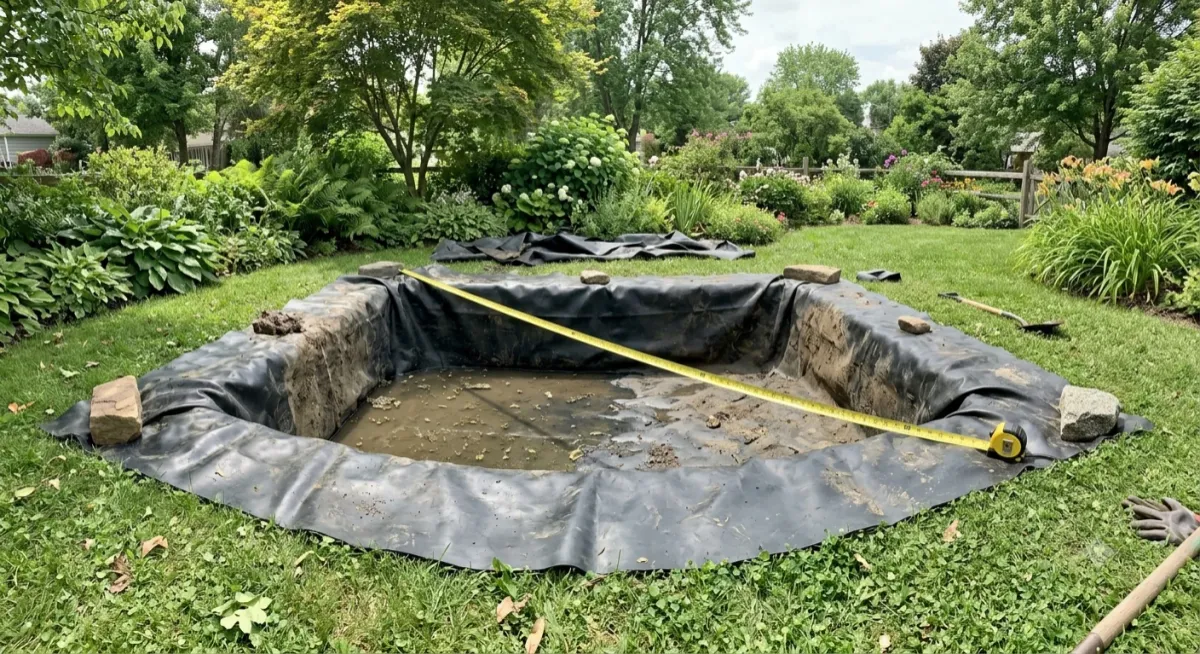
A pond liner has to be much bigger than the pond's surface. It covers the base, runs down and back up both walls, and still needs a margin at the edge to hold it in place. The formula is pond length plus twice the depth plus 2 feet, by pond width plus twice the depth plus 2 feet — so a 10 × 8 ft garden pond that is 2 ft deep needs a 16 × 14 ft liner, about 2.8 times its 80 sq ft surface. Ordering against the surface area, or eyeballing it, is the most common reason a liner comes up short at the edges.
This guide gives you the formula, a size chart for common pond sizes, worked examples from backyard ponds to farm reservoirs, and how to choose the right liner once you know the size.
The pond liner size formula
Measure the pond at its longest length, its widest width and its deepest point, then use:
Liner length = pond length + (2 × maximum depth) + 2 ft
Liner width = pond width + (2 × maximum depth) + 2 ft
Liner area = liner length × liner width
Depth is counted twice because the liner runs down one wall and back up the other. The extra 2 ft gives you 1 ft of overlap on every edge, which is what rocks, pavers or soil hold down.
Use the maximum depth even if the pond has planting shelves. The shelves sit inside the same profile, so the formula already covers them.
Pond liner size chart
Pond size (L × W) | Max depth | Liner size needed | Liner area | Pond surface |
|---|---|---|---|---|
6 × 4 ft | 1.5 ft | 11 × 9 ft | 99 sq ft | 24 sq ft |
8 × 6 ft | 2 ft | 14 × 12 ft | 168 sq ft | 48 sq ft |
10 × 8 ft | 2 ft | 16 × 14 ft | 224 sq ft | 80 sq ft |
12 × 10 ft | 2 ft | 18 × 16 ft | 288 sq ft | 120 sq ft |
15 × 10 ft | 2.5 ft | 22 × 17 ft | 374 sq ft | 150 sq ft |
20 × 15 ft | 3 ft | 28 × 23 ft | 644 sq ft | 300 sq ft |
20 × 15 ft | 4 ft | 30 × 25 ft | 750 sq ft | 300 sq ft |
30 × 20 ft | 4 ft | 40 × 30 ft | 1,200 sq ft | 600 sq ft |
If your pond falls between two rows, work it out with the formula and round up to the next available liner size. A liner that is slightly too big is trimmed in minutes. A liner that is too small cannot be fixed.
Worked examples
Backyard garden pond: 10 × 8 ft, 2 ft deep
Liner length = 10 + (2 × 2) + 2 = 16 ft
Liner width = 8 + (2 × 2) + 2 = 14 ft
Liner area = 16 × 14 = 224 sq ft, against 80 sq ft of pond surface
Koi pond: 20 × 15 ft, 4 ft deep
Koi ponds are usually dug deeper so the fish can overwinter, and that depth adds a lot of liner.
Liner length = 20 + (2 × 4) + 2 = 30 ft
Liner width = 15 + (2 × 4) + 2 = 25 ft
Liner area = 30 × 25 = 750 sq ft, against 300 sq ft of pond surface
The same pond at 3 ft deep needs 644 sq ft. That one extra foot of depth adds more than 100 sq ft of liner.
Farm pond or irrigation reservoir: 100 × 60 ft, 8 ft deep, with an anchor trench
Large ponds are normally secured in an anchor trench around the rim rather than under rocks, so allow about 3 ft per side instead of 1 ft.
Liner length = 100 + (2 × 8) + 6 = 122 ft
Liner width = 60 + (2 × 8) + 6 = 82 ft
Liner area = 122 × 82 = 10,004 sq ft, against 6,000 sq ft of pond surface
Notice the pattern: the smaller the pond, the bigger the gap between surface area and liner area. On a small garden pond the depth and edge overlap are large relative to the footprint, which is why small-pond builders are the most likely to under-order.
Measuring round, kidney and irregular ponds
A liner is a rectangle, whatever shape your pond is.
Round ponds: use the diameter as both the length and the width. A 10 ft round pond, 2 ft deep, needs a 16 × 16 ft liner.
Kidney, L-shaped and freeform ponds: run a tape across the longest point for length and the widest point for width, then apply the formula. The excess is folded or trimmed during installation.
Ponds with a waterfall or stream: size the stream liner separately from its own length, width and depth, and add 1 to 2 ft so it tucks under the main liner where the two meet.
A quick check before ordering: lay a rope or tape down into the hole and up the other side at the longest and widest points, add 2 ft, and compare the result with your calculation.
Don't forget the underlayment
A protective underlayment goes beneath the liner to guard against stones and roots, and it should be cut to the same size as the liner. BCP's pond liner installation guidelines recommend a soft geotextile underlayment for exactly this reason.
Choosing the right liner once you know the size
The size tells you how much liner to buy. The pond's size and use tell you which liner to buy.
Liner | Material | Thickness | Lifespan | Best for |
|---|---|---|---|---|
EPDM | 20 mil | 10–15 years | Small garden ponds, decorative water features | |
Reinforced EPDM | 30 mil | 15–20 years | Medium ponds, decorative and light commercial | |
Fish-safe PVC | 30 mil | 20–25 years | Large ponds, koi ponds, reservoirs, aquaculture | |
Reinforced RPE | 40 mil | 25+ years | Large-scale, agricultural and industrial containment |
As a rule of thumb, once the liner area passes a few hundred square feet, or the pond holds fish you care about, move up from the entry grade. Bigger liners carry more water weight and more exposed edge. If you are weighing materials, our EPDM vs PVC pond liner comparison covers the trade-offs, and very large projects are covered in our guide to industrial and commercial pond liners.
Frequently asked questions
How much bigger should a pond liner be than the pond?
The liner should measure the pond's length plus twice its maximum depth plus 2 ft, and the same for the width. For a typical backyard pond, that works out to two to three times the surface area.
What size liner do I need for a 10 × 10 pond?
At 2 ft deep, you need a 16 × 16 ft liner (256 sq ft). At 3 ft deep, you need an 18 × 18 ft liner (324 sq ft).
Do planting shelves change the liner size?
No. Measure to the deepest point and use that in the formula. The shelves sit inside that profile, so they are already covered.
How much overlap should a pond liner have around the edge?
At least 1 ft on every side for ponds edged with rocks or pavers, which is the 2 ft built into the formula. Larger ponds secured in an anchor trench typically need about 3 ft per side.
Should I round up or down?
Always round up. Extra liner is folded or trimmed during installation. A liner that is short at one edge has to be replaced or seamed, and seams are where most leaks start.
Is the underlayment the same size as the liner?
Yes. Cut it to the same dimensions so it protects the liner everywhere it touches the ground, including up the walls and over the edge.
Get the right liner for your pond
Before you order or ask for a recommendation, have ready:
Pond length and width at the longest and widest points
Maximum depth
Your calculated liner size from the formula above
Whether the pond will hold fish, irrigation water, or is purely decorative
Whether you need a single sheet or a liner fabricated to size
Best Construction Products supplies EPDM, reinforced EPDM, fish-safe PVC and reinforced RPE pond liners from 20 to 40 mil to landscapers, contractors, distributors and homeowners across the United States, and Pond Liner Ultra can be factory-fabricated to any dimension for large projects.
Request a pond liner recommendation
Send us your pond dimensions and intended use, and we will come back with the right liner, size and grade for your project. Or call the team on 877-540-5678.
