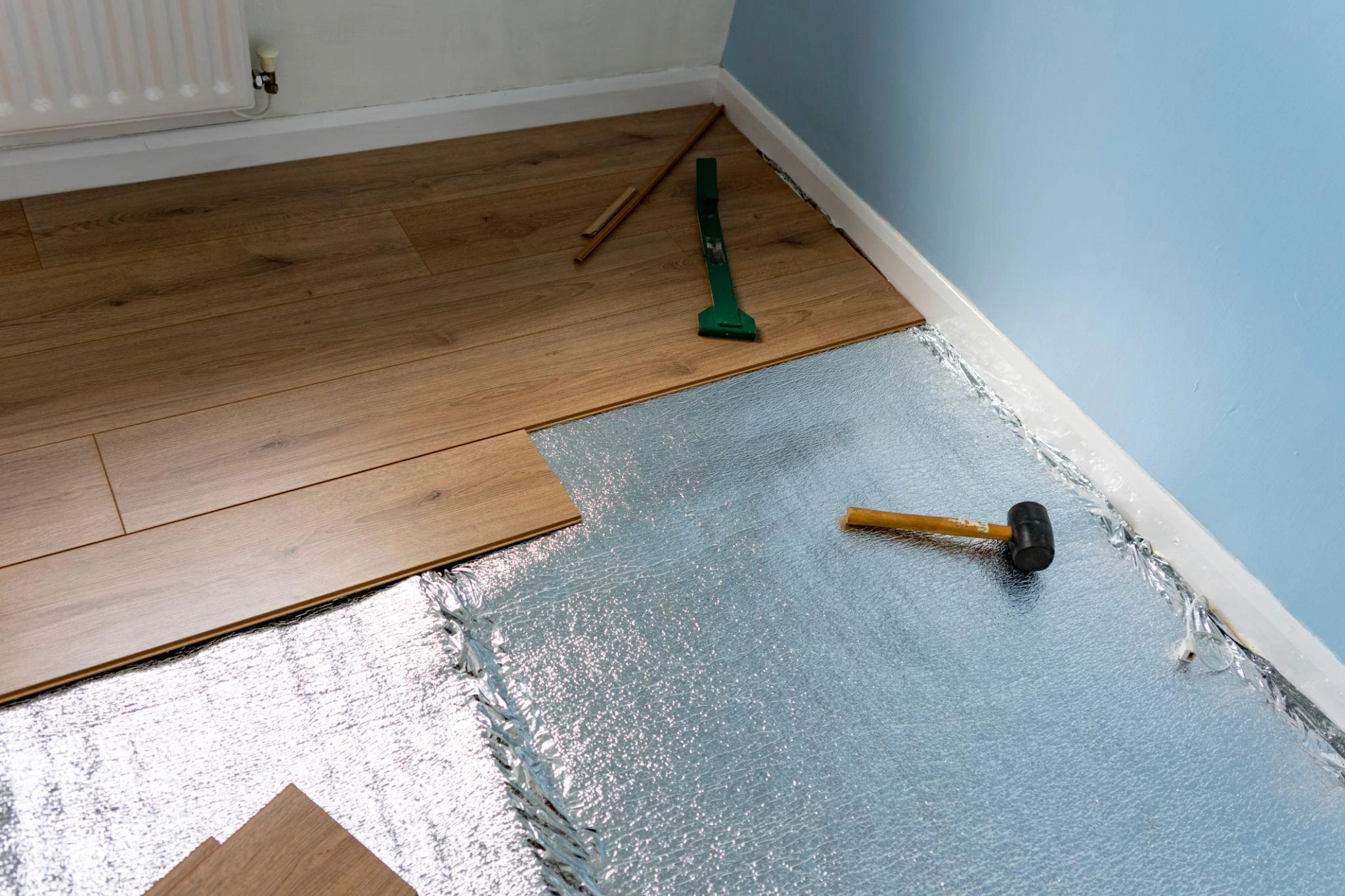
Underlayment for Laminate Flooring: Types, Thickness & Tips
Laminate is a floating floor, so it never sits straight on the subfloor. Something has to go between the two. For most laminate floors, the right underlayment is a thin, dense pad of about 2 to 3 mm, with a built-in vapor barrier if the floor goes over concrete.
This guide covers whether you need underlayment for laminate, the main types (foam, cross-linked polyethylene, cork, rubber and felt), how thick it should be, what changes on concrete and plywood, and how to lay it.
Putting down a different floor? See our guides to underlayment for vinyl plank flooring and underlayment for engineered hardwood.
Do you need underlayment for laminate flooring?
Yes, unless your laminate already has a pad attached to the back. Laminate planks click together and float, so the underlayment does several jobs at once:
Smooths small flaws in the subfloor so the click joints aren't stressed
Absorbs footfall noise, which stops the hollow "clicky" sound laminate is known for
Adds a little cushion and makes the floor feel warmer underfoot
Blocks moisture rising from concrete, when the underlayment has a vapor barrier
If your planks come with an attached pad, check the flooring maker's instructions before adding a second layer. Many makers only allow a plain vapor barrier film on concrete in that case, because two cushioned layers can make the floor flex and the joints fail.
Types of underlayment for laminate
Type | What it is | Good for | Watch out for |
|---|---|---|---|
Basic foam | Thin, light foam sheet | Budget jobs over wood subfloors in dry rooms | Little sound control; no moisture protection unless it has a film |
Foam with vapor barrier (2-in-1) | Foam bonded to a plastic or foil film | Concrete slabs and basements | Lay the film side as directed and tape the seams |
Cross-linked polyethylene | Dense, closed-cell foam | Better sound reduction and support | Costs more than basic foam |
Cork | Natural cork sheet | Sound control and warmth | Needs a separate vapor barrier on concrete |
Rubber | Dense rubber mat | Strong sound control in condos and upstairs rooms | Heavier; check it's rated for floating laminate |
Felt | Pressed fiber pad | Sound control and a solid feel | Usually needs a separate vapor barrier on concrete |
Foam vs dense underlayment
Foam underlayment for laminate flooring is the most common choice because it's cheap and easy to roll out. The trade-off is sound and support. Thin, soft foam can let the floor sound hollow and feel a little spongy. Denser materials, such as cross-linked polyethylene, keep the floor firm and cut more noise, which matters in upstairs rooms, apartments and open-plan spaces.
How thick should underlayment be for laminate?
Thicker isn't better. Laminate needs a firm base so the click joints stay tight.
2 to 3 mm is the usual range for laminate underlayment
Too thick or too soft lets the planks flex, and the joints can open or break over time
Follow your flooring maker's limit. Most laminate instructions state a maximum underlayment thickness, and going over it can affect the warranty
If the subfloor has dips or humps, fix them first. An underlayment smooths small flaws, but it won't level a floor.
Underlayment for laminate on concrete
Concrete slabs give off moisture vapor, so on concrete you need an underlayment with a built-in vapor barrier, or a separate vapor barrier film under the pad. Tape every seam so vapor can't find a gap.
We cover slabs in detail, including a simple moisture test and basement advice, in our guide to underlayment for concrete floors.
Underlayment for laminate on plywood or wood subfloors
Over plywood or OSB, the main jobs are sound control and smoothing small flaws. A vapor barrier isn't always needed over a wood subfloor in a dry room, but some flooring makers still ask for one, and it's sensible over a damp crawl space. Check that the subfloor is flat, dry and firmly fixed, with no squeaks or loose boards, before you start.
How to lay underlayment for laminate flooring
Prepare the subfloor. Sweep and vacuum, set any proud nail or screw heads, and fill low spots.
Check for moisture if you're on concrete or over a crawl space.
Roll out the first strip along the wall where you'll start the floor, with the vapor barrier side facing the way the instructions say.
Cut it to length with a utility knife. Don't run it up the walls unless the product calls for it.
Lay the next strip beside the first. Butt or overlap the seams as the product directs. Never let thick pads overlap and double up.
Tape the seams with a moisture-resistant tape, especially on concrete.
Lay only a few rows ahead of the flooring so you don't tear or crease the underlayment as you work.
Install the laminate as a floating floor on top, leaving the expansion gap your flooring maker specifies around the edges.
Do you staple underlayment for laminate?
Usually not. Laminate underlayment floats with the floor. On a wood subfloor, a few staples or a strip of tape can hold it still while you work, but check the product instructions first. Never staple through a vapor barrier on concrete.
Common mistakes
Doubling up a separate pad under laminate that already has one attached
Using a pad that's too thick or too soft, which flexes the joints
Plain foam on concrete with no vapor barrier
Leaving seams untaped where moisture protection matters
Expecting the underlayment to level the floor. Level first, then lay the pad.
BCP SilentShield for laminate floors
BCP SilentShield Floor Underlay is made for laminate, engineered hardwood, luxury vinyl and other floating floors. It's compatible with most click-lock flooring systems and works over concrete or wood subfloors.
Feature | BCP SilentShield Floor Underlay |
|---|---|
Material | High-density foam or cross-linked polyethylene |
Thickness | 2 mm to 3 mm |
Sound rating | IIC ≥ 70, STC ≥ 65 (varies by floor type) |
Moisture barrier | Yes, integrated vapor barrier film |
Mold and mildew | Built-in antimicrobial properties |
Floor compatibility | Laminate, LVP, engineered hardwood, floating floors |
Radiant heat | Compatible with underfloor heating |
Roll sizes | 3' x 30' (90 sq ft) and 4' x 100' (400 sq ft) |
To install it, roll it out with the vapor barrier side facing up, overlap the seams 2 to 4 inches and seal them with moisture-resistant tape. Then float the laminate directly on top. Pre-marked grid lines on the roll make straight cuts easier.
Frequently asked questions
What is the best underlayment for laminate flooring?
A thin, dense underlayment of about 2 to 3 mm that suits your subfloor. On concrete, choose one with a built-in vapor barrier. Upstairs or in an apartment, look for a strong sound rating.
Can you put laminate flooring down without underlayment?
Only if the planks have an attached pad and the flooring maker allows it. Laminate without any underlayment tends to sound hollow and can be damaged by subfloor flaws or moisture.
Is foam underlayment good for laminate?
Yes, for many rooms. Basic foam is fine over a dry wood subfloor on a budget. On concrete it needs a vapor barrier, and denser foam or cross-linked polyethylene gives better sound control.
Which side of the underlayment goes down for laminate?
It depends on the product, so follow the printing on the roll. For SilentShield, the vapor barrier side faces up.
Do I need a moisture barrier under laminate flooring?
On concrete and over damp crawl spaces, yes. You can use an underlayment with a built-in vapor barrier or a separate vapor barrier film. Over a dry wood subfloor, follow your flooring maker's instructions.
Get the right underlayment for your laminate
Before you order, have ready:
The room's square footage
Your subfloor type (concrete, plywood or OSB)
Whether the planks have an attached pad
Whether the room is upstairs, in a basement or over radiant heat
Request a floor underlay quote
Send us your room size and subfloor type and our team will work out how many rolls you need. Or call 877-540-5678.
